Which Hairstyle Is Right for Me? Your Complete Guide
Why Choosing the Right Hairstyle Feels So Overwhelming
Picture this: you're sitting in a salon chair, phone in hand, scrolling through styles that look incredible on someone else. The question circling your mind — which hairstyle is actually right for me? — feels genuinely impossible to answer.
That feeling is almost universal. And it usually traces back to one problem: most hairstyle advice is written as if everyone has the same face, the same hair, and the same life.
You don't.
Your situation is a specific combination of factors that don't apply to anyone else in quite the same way.
There is no universally correct hairstyle — only the one that best serves the life and goals of the person wearing it.
Think of your hairstyle choice less like a beauty decision and more like a personal equation. The variables are real and knowable: face shape, hair texture, daily routine, professional context, and where your appearance will actually be seen — in person, on camera, or in photos.
Before diving into each factor, here's a quick reference to anchor your thinking.
Quick Hairstyle Direction by Goal
Different situations call for different signals, and your hairstyle communicates something before you say a single word. Use this table to get your bearings quickly, then read deeper into whichever sections apply to your situation.
| Your Goal | Recommended Style Direction | Key Signal It Sends |
|---|---|---|
| LinkedIn headshot | Clean lines, face-framing, polished | Credibility and focus |
| Dating profile | Soft waves or relaxed styling | Warmth and approachability |
| Creative portfolio | Bold cut or natural texture | Confidence and individuality |
| Casual social presence | Effortless, low-maintenance look | Authenticity and ease |
| Corporate bio photo | Sleek, structured, conservative | Professionalism and reliability |
The key takeaway here is simple: each goal sends a genuinely different message. Choosing intentionally — rather than just going with whatever felt easy last time — is what separates a hairstyle that works for you from one that merely exists on your head.
Here's exactly what this guide walks through:
- The psychology behind why hairstyles create immediate impressions on other people
- Face shape and hair texture as your non-negotiable starting point
- Lifestyle and profession as practical filters that narrow your realistic options
- Social and dating contexts where warmth and approachability consistently outperform polish
- Digital tools that let you preview different looks before you commit to anything in a salon
No beauty-magazine generalizations. Just concrete, practical guidance built around the variables that actually matter for your specific situation.
Why Your Hairstyle Sends a Message Before You Speak
Your hairstyle is working constantly — even when you're silent. Before a single word leaves your mouth, the person across from you has already formed an impression based on what they see.
Think of your hairstyle as the cover of a book. Nobody has read a word yet, but they already have feelings about what's inside.

What Different Styles Actually Signal
These associations didn't appear out of nowhere. They've been built up over decades through cultural norms, workplace expectations, and the way media portrays certain looks — and they stick around whether we like it or not:
- Sleek, smooth styles tend to signal control and professionalism
- Soft waves communicate warmth and approachability
- Bold cuts or natural textures often read as confidence and individuality
- Polished updos suggest someone who is grounded and self-assured
Knowing this isn't about caving to other people's expectations. It's about understanding the rules well enough to use them on your own terms.
The Two-Second Window That Matters Most
The research on first impressions is genuinely striking — and very relevant when you're trying to figure out which hairstyle actually works for you.
Hair is far more than a style preference. It shapes how people judge your age, health, attractiveness, and professionalism within seconds of meeting you.
One study found that straight hair made people appear roughly five years younger than wavy hair — a meaningful shift driven entirely by hairstyle. Separate impression research showed that hairstyle variations significantly changed how intelligent, attractive, and "well put together" someone appeared, with those effects registering after just about two seconds of viewing. Read the full research on how hairstyle shapes perception.
That window closes fast. Your hairstyle fills it whether you've thought about it or not.
Where This Matters Most
The stakes are especially high in specific situations that most people tend to underestimate:
- A LinkedIn headshot — often the very first professional impression a recruiter sees
- A company bio photo — a quiet signal about your credibility and how well you fit the role
- A dating app profile — where warmth and personality do the heavy lifting
Each of those moments is a first impression you don't get a second shot at. The gap between a deliberate hairstyle choice and a default one shows up most clearly in exactly these situations.
The goal isn't perfection. It's intention — picking a style that actually sends the message you want to send, in the moments where it matters most to you.
How Face Shape and Hair Texture Define Your Best Options
Think of your face shape as the architectural blueprint of your head, and your hair texture as the actual building material you're working with. Figuring out which hairstyle is right for you starts here — before lifestyle, trends, or anything else enters the conversation.
These two factors form your foundation. Everything else gets layered on top.
Reading Your Face Shape as a Starting Point
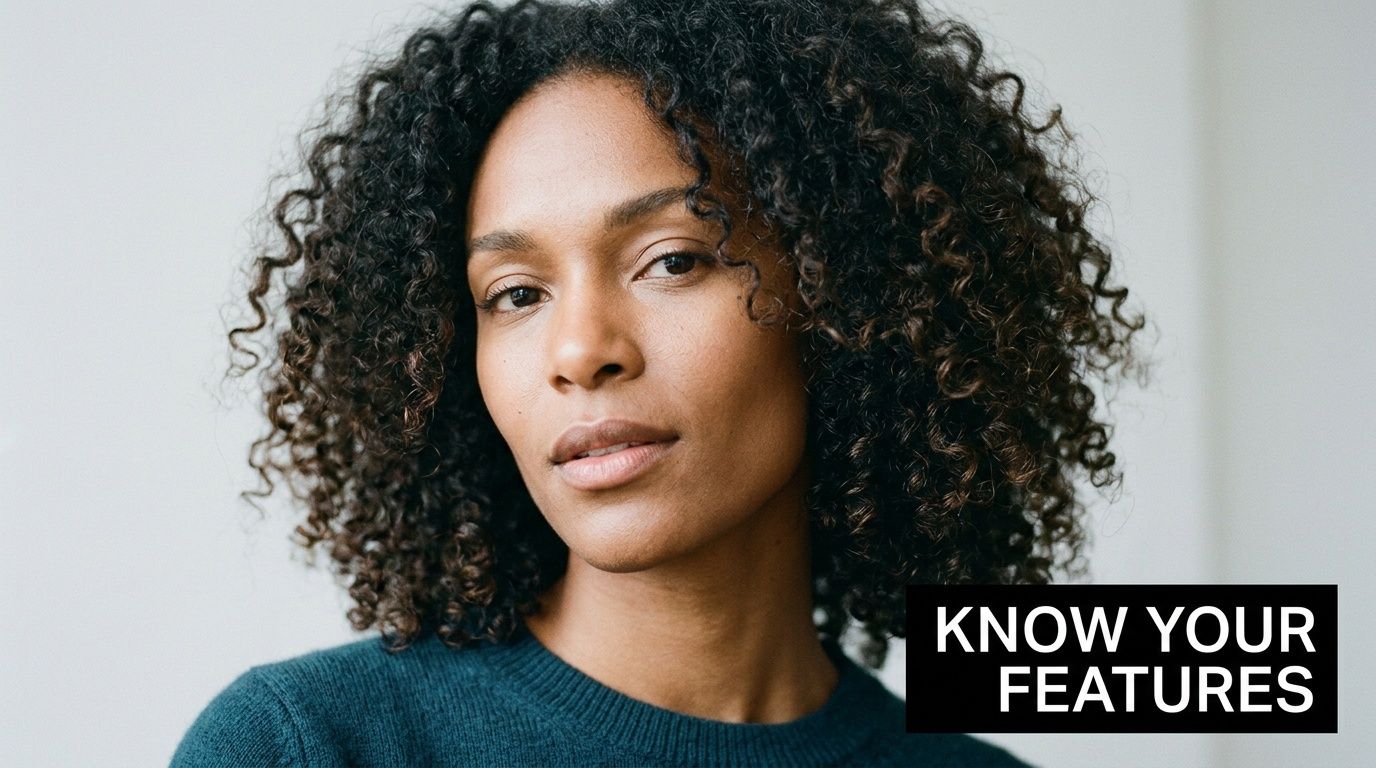
There are six common face shapes, and each one responds differently to length, volume, and overall silhouette. Understanding which category you fall into is essentially like knowing which proportions you're working with before deciding what to build around them.
Here's how each shape generally responds to styling:
- Round — full and wide at the cheeks — benefits from styles that add height and reduce width, like long layers or a high bun
- Square — strong jaw and broad forehead — softens beautifully with waves and layered cuts that break up sharp angles
- Heart-shaped — wide at the temples, narrower at the chin — balances well with volume added at the jaw or chin area
- Oblong — longer than it is wide — wants width, not more length; avoid very long, straight styles that extend the face further
- Diamond — wide cheekbones, narrower forehead and jaw — suits styles that add width at the top or bottom
- Oval — considered the most flexible shape — works with almost any silhouette and length
Key Insight: Oval and diamond face shapes tend to have the most styling flexibility. If you're genuinely unsure of your shape, take a straight-on selfie, trace your outline on screen, and compare it against these six profiles.
Layering in Hair Texture
Once you have your face shape figured out, texture becomes the second half of the equation — and it changes everything.
Choosing a style without accounting for texture is like picking a recipe without checking what's actually in your kitchen. Technically possible, but very likely to go sideways.
Here's how different textures typically behave:
- Fine hair tends to go flat under blunt, heavy cuts — it looks best with movement, layers, and volume-building techniques
- Thick hair holds shape well but can fight a sleek, polished style without precise cutting that removes bulk
- Natural curls thrive with layered approaches that let each curl move independently, rather than weighing the whole mass down
Why These Two Factors Come First
Neither shape nor texture works in isolation. A layered style that flatters a heart-shaped face still needs to be calibrated differently for someone with fine hair versus thick, coarse hair.
The practical sequence: Identify your face shape first. Then honestly assess what your texture realistically allows — not what you wish it allowed. That combination alone narrows your options meaningfully before you ever factor in lifestyle or trends.
Your profession, daily routine, and personal preferences all matter, of course. But they filter down from this starting point, not the other way around.
Matching Your Hairstyle to Your Lifestyle and Profession
A hairstyle can be technically perfect for your face shape and still be completely wrong for your actual life.
Think about someone who falls head over heels for a glossy, high-maintenance blowout — but works out five days a week, lives somewhere humid, and has a seven-minute morning routine. That style will make them miserable within a week. Looking great in theory and looking great in practice are two very different things.
Before committing to any cut or color, do an honest audit of your daily reality.
The Lifestyle Questions Worth Asking First
These aren't optional considerations — they're practical filters that eliminate styles before you waste time or money:
- How much morning time can you realistically give your hair? Not the optimistic version. The real one.
- How often can you get to a salon? Some styles need trimming every four weeks just to hold their shape.
- Does your climate work against certain styles? Humidity destroys precision cuts. Dry air amplifies frizz.
- Does your job involve physical activity? Healthcare, fitness, and outdoor roles need styles that stay functional under movement.
Answering these honestly narrows your options quickly — and saves you from a beautiful cut you'll resent by week three.
How Your Profession Shapes the Decision
Different industries have genuinely different visual norms, and understanding that context is part of figuring out which hairstyle actually works for you.
Finance and law tend to reward polished, conservative styles. Creative fields give far more room to experiment. Healthcare prioritizes styles that stay completely out of the way.
Your professional hairstyle isn't just about looking good — it's a signal about how well you understand the environment you're operating in.
And then there's a dimension of professional context that deserves to be named directly rather than softened.
The Bias That Shapes Workplace Hair Decisions
Research consistently shows that natural and Afro-textured hairstyles face disproportionate scrutiny in professional settings. The data makes this concrete: 66% of Black women change their hair for a job interview, and 41% of those who change it switch from curly to straight. Black women's hair is 2.5 times more likely to be perceived as unprofessional, and 44% of Black women under 34 feel pressure to use a straight-hair headshot professionally. Read the full research on workplace hair discrimination.
Knowing that bias exists gives you agency to navigate it deliberately — rather than simply absorbing it without context.
Digital Professionalism Counts Too
That same intentionality extends to your online presence. The hairstyle you choose for a LinkedIn headshot or a company website photo deserves as much thought as what you'd wear to an important interview.
Read also: How to Dress for a Professional Headshot — because your hairstyle and outfit work together as a single visual statement in every professional photo.
The most effective professional photos are ones where every visible choice — clothing, styling, expression — is sending exactly the same message.
Choosing a Hairstyle for Your Social and Dating Profile
Your LinkedIn headshot and your Hinge profile photo might show the exact same face — but the hairstyle doing the work in each one should be telling a very different story.
Social and dating contexts reward warmth, approachability, and personality in ways that professional photos simply don't prioritize. Figuring out which hairstyle is right for you in these settings means thinking about the emotional signal you want to send, not just the polished one.

What the Research Actually Shows About Hair and Attraction
The data here is more specific than most people expect.
In a widely cited survey, nearly half of single men described women with curly or wavy hair as sexy and irresistible. Around 50% viewed an updo as down to earth, while a quarter saw braided hair as sporty and adventurous — and straight, sleek hair was more associated with long-term commitment than immediate attraction. Explore the full findings on hairstyle and attraction perception.
These patterns aren't random. Different styles send genuinely different signals, and social platforms amplify those signals because a photo is often the entire first impression.
Here's how the most common styles tend to read in dating and social contexts:
- Soft waves and curls — signal warmth, openness, and approachability
- Polished updos — read as grounded and self-assured without feeling cold
- Braids and natural styles — communicate confidence and individuality
- Sleek, straight styles — project composure but can feel less immediately warm
The Same Hair, Two Completely Different Photos
This distinction is easier to grasp with a real-world example.
Picture someone building profile photos for two platforms on the same afternoon. For a professional networking site, they go with a sleek, face-framing style that signals focus and credibility. For a dating app shot taken the same day, they wear that exact same hair slightly looser and more relaxed — same length, softer finish, completely different impression on the viewer.
That's not dishonesty. That's intentional styling for the specific message each platform needs.
Testing Your Look Before You Commit
This is where AI-powered preview tools genuinely earn their place in the process.
Platforms like FlowHeadshots let you generate polished, realistic photos showing you in different styles across different contexts — so you can compare how a particular look actually reads before you ever sit in a stylist's chair.
For photos that will live on your profiles for months, that kind of digital testing isn't a luxury. It's genuinely smart planning.
Read also: How to Choose the Best Photos for Dating Apps — because the hairstyle is only one part of what makes a dating profile photo work.
Practical Takeaways for Social Styling
Before settling on a hairstyle for any social or dating photo, ask yourself three things:
- What feeling do I want someone to have within the first two seconds of seeing my photo?
- Does this style match the platform's tone — casual and warm, or polished and purposeful?
- Have I previewed this look digitally or tested it in photos before committing?
The right hairstyle for a dating profile isn't necessarily your most impressive one. It's the one that most accurately represents who you are — and makes the right person want to know more.
How to Preview and Test Hairstyles Before Committing
The old way to test a new hairstyle was straightforward, if nerve-wracking: bring a photo to your stylist, hope they could mentally map it onto your specific face, and brace yourself for whatever came next.
That approach has always been a leap of faith. Fortunately, you have far better options now.
Start with the Traditional Toolkit
Before reaching for any app, the basics still matter. These methods give you real, tactile feedback before you commit to anything permanent:
- Inspiration photos from stylists whose work you genuinely trust — not just celebrity shots that completely ignore your hair texture
- Wigs and clip-in extensions to test length and volume without making any lasting change
- In-person consultations where a professional can assess your actual texture and face shape together, under real lighting, with their own trained eye
These approaches take time, but the feedback feels grounded and personal in a way that's hard to replicate otherwise.
What AI-Powered Platforms Have Changed
Then consider what tools like FlowHeadshots have made possible.
You upload existing photos, choose from a wide range of styles and contexts, and generate studio-quality, photorealistic images of yourself in those looks. The results are realistic enough to use immediately on LinkedIn, a resume, or a dating profile.
The practical benefit is hard to overstate: instead of wondering whether a bob would actually work for your corporate headshot, you can generate and compare five options in minutes — and pick the most flattering before ever touching a pair of scissors.
Learn more about getting the best angles for selfies you'd use in that process — because the photos you upload directly affect how useful your generated results will be.
How to Evaluate Any AI Styling Tool
Not all preview tools deliver equal results. When comparing options, look for:
- Photorealistic output quality — results that look like actual photos, not obvious filters or cartoonish renderings
- Meaningful style variety — enough options to genuinely compare looks side by side
- Clear privacy policies — you're uploading your face, so how that data is handled matters
- Professionally usable results — outputs you can actually put to work beyond novelty or curiosity
Traditional vs. AI-Powered Hairstyle Preview Methods
Most people don't realize how much the preview method itself shapes the decision. Here's how the main approaches stack up across the factors that actually matter.
| Method | Cost | Time Required | Realism Level | Output Usable Professionally |
|---|---|---|---|---|
| Stylist consultation | Medium | 30–60 minutes | High | No |
| Wig or extensions | Medium–High | Hours of testing | Medium | No |
| Inspiration photo only | Free | Minutes | Low | No |
| AI headshot platform | Low | Minutes | Very High | Yes |
The gap between inspiration photos and AI-generated previews is significant — one gives you a rough idea, the other shows you you in that style. For anyone making a decision that affects their professional image or daily routine, that difference is worth paying attention to.
The right answer to "Which hairstyle is right for me?" almost always benefits from previewing before deciding. The tools available now make that easier than it has ever been.
Your Personal Hairstyle Decision Framework
Throughout this guide, we've looked at hairstyle choices through several different lenses — face shape, texture, daily lifestyle, professional context, social goals, and digital previewing tools. Now it's time to bring all of that together into a practical decision sequence you can actually follow.
Think of it as the recipe card at the end of a long cooking tutorial.
The infographic below maps out all five questions in a single visual checklist — use it as your reference point before committing to any new look.
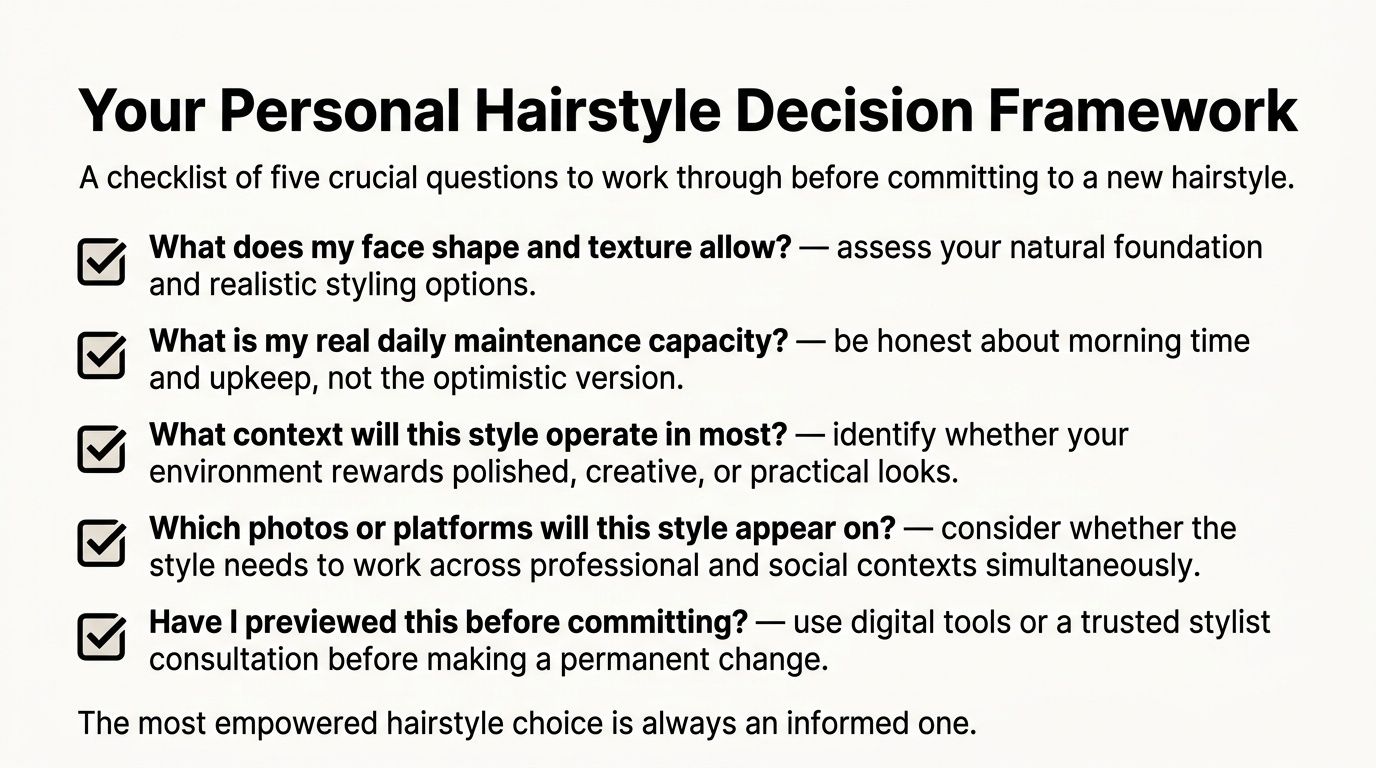
Every checkpoint reinforces the same core truth: the most common hairstyle mistake isn't choosing the wrong cut — it's skipping the honest self-assessment altogether.
Five Questions to Work Through in Order
Go through these in sequence, and resist the temptation to answer with what sounds ideal. Answer with what's genuinely true about your life.
What does my face shape and hair texture realistically allow? Start here, with your natural foundation, before anything else enters the picture.
What is my actual daily maintenance capacity? Not the optimistic version — the real one, on a rushed Tuesday morning when you're already running late.
What professional or social environment will this style live in most often? Different contexts send different signals, and that matters more than most people admit.
Which specific settings — photos, platforms, workplaces — does this style need to perform in? Some looks work brilliantly in one context and fall flat in another.
Have I previewed this style digitally or talked it through with a professional before committing? Tools like FlowHeadshots make this step genuinely useful rather than just a nice-to-have.
Why This Sequence Works
Notice the direction these questions move — from fixed factors you can't change, like face shape and natural texture, toward flexible ones, like virtual previewing and professional input.
The most empowered hairstyle choice is always an informed one.
That progression matters. It stops you from falling in love with a style that looks incredible on someone else but quietly ignores your actual starting point.
Figuring out which hairstyle is right for you isn't about tracking down a universal answer. It's about finding your answer — the one that fits your face, works within your life, and makes sense for where you're headed.
Frequently Asked Questions About Choosing the Right Hairstyle
How Do I Figure Out My Face Shape at Home?
You don't need a professional for this — just a flexible tape measure and about five minutes in front of a mirror.
Measure four things while looking straight ahead:
- Forehead width — temple to temple, across your hairline
- Cheekbone width — across the widest point of your cheeks
- Jawline width — from one corner of your jaw to the other
- Face length — from your hairline to the bottom of your chin
Take those four numbers and compare them against the six common face shapes: round, oval, square, heart, oblong, and diamond. No tape measure? Snap a straight-on selfie, open it on your screen, and trace your outline with your finger or a dry-erase marker. Matching that shape against reference images is surprisingly accurate.
Can I Use an AI Headshot Platform Just to Preview Styles?
Absolutely — and you don't have to be planning an actual haircut to get value from it.
Tools like FlowHeadshots generate photorealistic images of you in different hairstyles and professional settings. The results are polished enough to use right away on LinkedIn, a resume, or a company bio — no salon visit required.
Which Hairstyle Works Best for a LinkedIn Headshot?
A few principles hold true across most industries: clean lines, styles that frame rather than overwhelm your face, and a look that fits your field's visual norms without losing what makes you recognizable.
The goal isn't the most impressive style — it's the most you style that reads clearly and professionally in a small rectangular photo.
Does Hair Color Matter as Much as Hairstyle?
Color plays a real but supporting role. It influences perceived warmth, energy, and sometimes age — but shape, length, and overall styling consistently have a stronger effect on how polished and professional someone looks.
Think of color as the accent wall and your cut as the room's architecture. The architecture always comes first.
FlowHeadshots makes it easy to test hairstyles virtually before committing — and walk away with studio-quality photos you can actually use. Visit FlowHeadshots to generate your professional headshot today.
Enjoyed this article? Share it with your network.
Ready to get your AI headshots?
Professional photos in 60 seconds. No photoshoot required.
Get Started Free